Podcasting for free (what is essential)
» What is a podcast? «
Technically, a podcast is just a list of audio files, listed on a RSS feed. But maybe this is too simplistic.
Let’s state the most important things about podcasting, in 3 different categories: essential, recommended, optional.
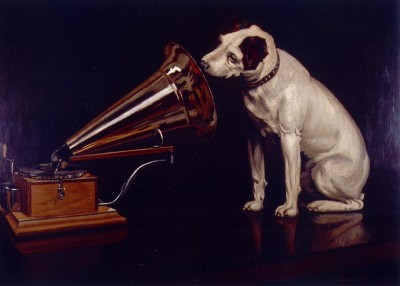
"Dog Looking at and Listening to a Phonograph” by Beverly & Pack is licensed under CC BY 2.0

Essential
Content
The most important thing in a podcast is the content - it is the podcast soul and it is what listeners get.
Capturing
This is one crucial point regarding the podcast quality. Unfortunately, there are no shortcuts on this one: in order to have quality, a good microphone is a must (but it’s not the only thing!). Nevertheless, if your objective is to experiment and to learn, there are free options (that was made at Marmita de Redon).
Audio files: digital episodes
This is how the content is sent to the listeners - and audio file, usually MP3 format This file must be hosted on a publicly accessible website.
Hosting
There are multiple options for hosting this files, some cheaper or more expensive, other free/libre or proprietary, etc. We have some examples: archive.org, S3 from AWS, Dropbox/Drive/OneDrive, or even the podcast website.
RSS Feed
This is a critical part of the podcasting engine. The podcast directories (Apple Podcasts, Spotify, etc.) require an RSS feed in order to add a podcast to their lists.
An RSS feed is nothing but an XML formatted file, read and analyzed by computers, with all information about the podcast (title, authors, thumbnail …), including all episodes list (and their respective audio file location).
From this feed, listeners are notified when a new episode is available (though podcatchers).
Recommended
Official website
Although it is not mandatory, the website is probably the best place to find some information about the podcast, like the authors contact.
An easy alternative to a conventional website, are the podcast platforms, which provide a “face” for the podcast, with the episodes list and their show notes.
Social networks
Nowadays the marketing is a key part of a podcast success. How will you search for the podcast you never heard about?
Brand
From the opening theme to colors and image, this is usually the first contact one has with the podcast. A consistent image which represents the brand (podcast) will show commitment and professionalism.
Statistics
Knowing how many times each episode was downloaded may have or have not any consequence, but there is always that desire to know how many people listen to our words.
Optional
Periodicity
If episodes are released with a fixed periodicity, listeners will feel the podcast as “healthier”.
Monetization
This may even be one of the core objectives (though I do not recommend it). Getting money from podcasting is possible, if you have a relatively large audience. This is mostly achieved through ads, usually by negotiating with brands in order for them to be featured on the episodes.
A plan
What’s next? Should I keep this project for 3 monthly listeners? How many listeners should I have before taking podcast to a professional level? Should I hire services now, or should I wait for X followers?
Making this kind of plans from the beginning may become very useful when those questions arise.
How to make it for free
Presenting a practical example is better than explaining everything. This is how it was made with Marmita de Redon podcast
| What | How |
|---|---|
| Content | A group of 4 friends keeps thinking about what to talk next episode |
| Capturing | In order to capture with minimum quality, we record every episode with our smartphones. I dare to say this is the only thing you cannot get professional for free |
| Audio files | Each episode is edited and rendered using open source Audacity and rendered as a stereo MP3 at 192kbps |
| Hosting | Every episode is uploaded to the archive.org |
| RSS Feed | Custom made source code, in order to fully support podcasting RSS feeds (code on Github) |
| Official website | Website made using Hugo - a static site framework and hosted on Github Pages for free (code on Github) |
| Social networks | Free accounts at Instagram, Facebook, Twitter, Youtube, Github, Disqus |
| Brand | Vector images edited with Inkscape, using open source materials from Flaticon and open sourced at Github. Colors are coherent among the website, thumbnails and social networks |
| Statistics | You can get free basic statistics provided by Blubrry |
| Periodicity | Weekly, every friday morning |
| Monetization | No |
| A Plan | Personal satisfaction, hearing our customers and feel our gut 😛 |
Moreover, the Marmita de Redon podcast is completely open source, and its code is available (suggestions are welcome) at github.com/marmita-de-redon
This is the 1st article from the series How to make a Podcast:
- Podcasting for free (the essentials)
- Recording and capturing
- Sound editing
- Brand: music, image and licencing
- Website
- Submission and publishing (iTunes, Spotify, etc…)
- Social Network
- Automation